Laminating Salvaged Steel - HWF's take on san mai
Read how Heartwood Forge is making the most of recycled steel through the ancient san mai technique.
Read More
Read how Heartwood Forge is making the most of recycled steel through the ancient san mai technique.
Read MoreLast year I raffled off a chefs knife. To enter, all you had to do was purchase a Heartwood Forge t-shirt. Keeping track of the orders was a lot of work but it was also a lot of fun. And I'm doing it again. This year, Lee convinced me to print a ladies shirt and we've added that to the available line up.
ABOUT THE KNIFE:
The knife up for grabs is a hand forged chefs knife (pictured above) made from part of an antique lumber mill saw I recovered outside of Asheville, NC. The steel tested as 1095 which is one of my personal favorites to use in the shop and in the kitchen. The handle is a simple western styled full tang, dressed in bloodwood.
HOW TO ENTER:
Purchase a new ladies tank or the smith hammered tee (<<click links)). Shipping is included in the price. Once they're gone, they're gone.
OFFICIAL RULES:
Enter as many times as you like. Each shirt counts as one entry.
WHEN WILL I BE NOTIFIED?
The winner will be contacted via email once we have selected the winner. Drawing will be held on Monday, June 12, 2017 at 3pm EST.


There's so much to say about why I do this. Waste not. Tell a story. Preserve yesterday. Love people. Eat well. Build community. I can't really put my finger on one reason. But, one thing remains the same, when the opportunity arises, I am always thrilled to have a new opportunity to give back to my community. In this case, I put my head together with Get Comfortable & United Way of Northeast Georgia to auction off a knife - benefiting those in need in the Athens community. To create this knife, I partnered with Creature Comforts Brewery, founders of the Get Comfortable campaign/organization and I wanted to honor their efforts - highlighting the positive change they are bringing to our area. We are truly lucky to have Chris Herron (Creature Comforts CEO) in our ranks of local business owners. He's a force to be reckoned with and after hearing him speak at a recent My Athens Go Getters event, Lee and I were moved to take action.
Ill let the photos below speak for themselves. We acquired part of a damaged whiskey barrel that Creature Comforts was using to age a project brew - which included an iron strap/hoop which I used for the san mai cladding & two oak staves that I used for the handle.
San mai is a Japanese laminated steel - the cladding is a softer, more malleable alloy, sometimes it's pure iron and many makers are using stainless steel. The point is that the cladding remains soft throughout the heat treating process and protects the very hard core steel, allowing you to harden the steel to a higher HRC without risk of cracking or breaking. It's a beautiful process that master bladesmith, Bill Burke, taught me about while in Idaho this past winter.
Check out the photos and be sure check out Creature Comforts' Get Comfortable campaign and United Way of North East Georgia.
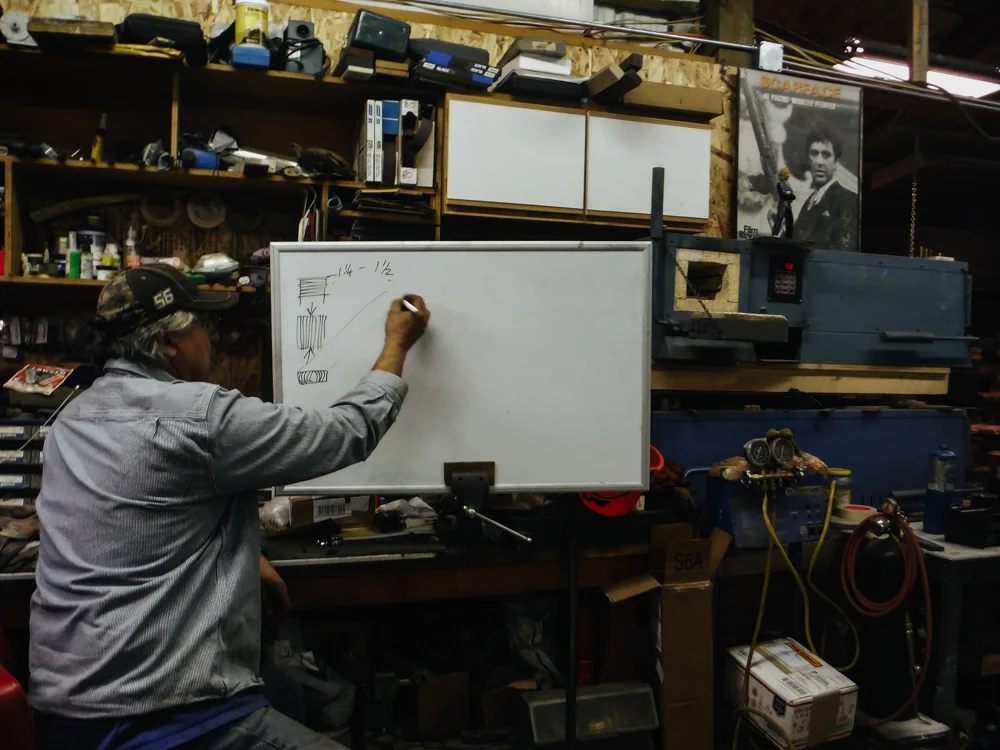
The idea of learning from an accomplished knife maker like Bill Burke has long been a dream of mine. There was no doubt in my mind it would be humbling experience but I also believe that education is a life long investment. If you learn something today, it will likely serve you well for the rest of your life. It took a while to decide who I'd like to study with and how long I should devote to such an experience - in hind sight, it's the act of doing it that is more important as I delayed (read, saved) for a couple of years, considering the decision. I only wish I had decided to do this earlier.
As I have responsibilities to run Heartwood Forge and continue making custom knives, the thought of taking off a week of work to learn was daunting, until I had the reassuring thought that this educational experience will positively affect my work for the rest of my life... and my customers will likely be the largest beneficiaries of such an endeavor. That made the decision very easy. If you read my previous post about making damascus & san mai, you'll understand that I've confirmed a thirst of knowledge and exploration this year that will likely continue to snowball. And Bill Burke's shop outside of Boise, ID is where a lot of momentum was gained.
The week was 5 full days of working. Making knives, making pattern welded/damascus steel with coaching on technique and sit down, class-room-type instruction on theory, approach and practice. Bill is super talented and knowledgable and opened my eyes to the possibilities of pattern welded steel. He and his son create some of the most mind boggling patterns ever. My only experience with making damascus and san mai was about a month prior in my own shop and I feel that because of that, I was able to get more out of my time in Idaho. While my focus was on san mai and heat treating, we spent a considerable amount of time on pattern welded steel and touched on some basics of forging and grinding as well. It will be exciting to see this play itself out in my shop over the next few years.
While there, we experienced some pretty heavy winter weather and Bill & Patti Burke invited me to sleep in their basement to avoid making the snowy mountainous drive every morning and evening. I rushed back to Boise and checked out of my AirBnB, got my things and scurried back up the hill to Bill's shop for the rest of the week. They were selfless and fed me and took care of me like the refugee I felt like - a native southerner, stuck in wettest winter Boise has had in 20 years. Easily distracted by great weather and technology, it was really amazing to disconnect for a week, hole up in a snow surrounded compound and study what I love the most with one of my all time favorite knife makers. Turns out he's an outstanding person as well!
Be sure to check out Bill Burke's work!
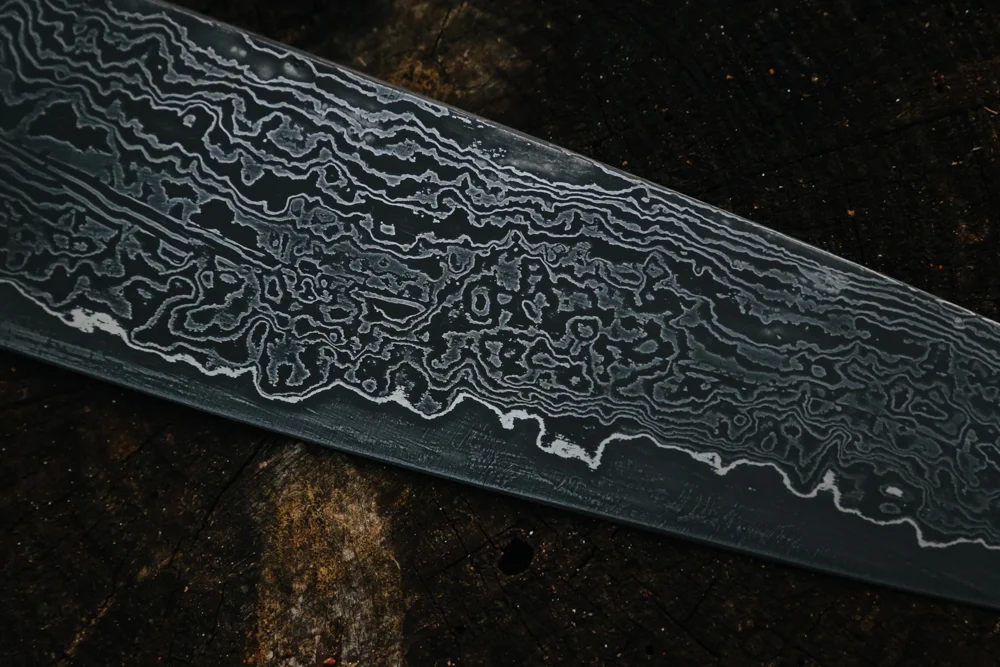
Damascus/Random Pattern Welded Steel made using old saw blades: the lighter is a high nickel alloy bandsaw steel from central Georgia while the darker alloy is a mid carbon 10-series steel from a homestead sawmill, dating back over a century. The core steel is US made virgin 52100 with a pure nickel liner (the brightest line).
As part of my personal journey as a craftsperson, knife maker and artist, I have been chomping at the bit to push my creative boundaries in the new year. The reality is that I love what I do, but I must continue to grow through creative exploration. Perhaps that's why we have a newly renovated website, a shop addition in the works and a even a class (to attend) on the schedule for late/early February.
I've always been intrigued by pattern welded steel - largely accepted as damascus steel - a process of combining multiple alloys &/or iron to create an improved homogeneous steel with better performance but more know for its display of a beautiful pattern. Though, with so many amazing modern alloys available today, this process never completely made sense to me. In modern times, it seems a purely aesthetic endeavor that puts a ton of demand on our most valuable resources - time, labor & fuel - and I just couldn't justify it! However, after collecting countless saw blades over the past 6 years, it is time to figure out what to do with some of this excess steel. Even I have been known to even cull the library of steel from time to time as some retired lumber mill saw blades just aren't good for making skinny, hard cutting tools.
Giving in to my creative itch, I've decided to experiment with making damascus / pattern welded steel out of the steel that isn't reserved for chefs knives. It seems to me like the perfect outlet for too much steel.
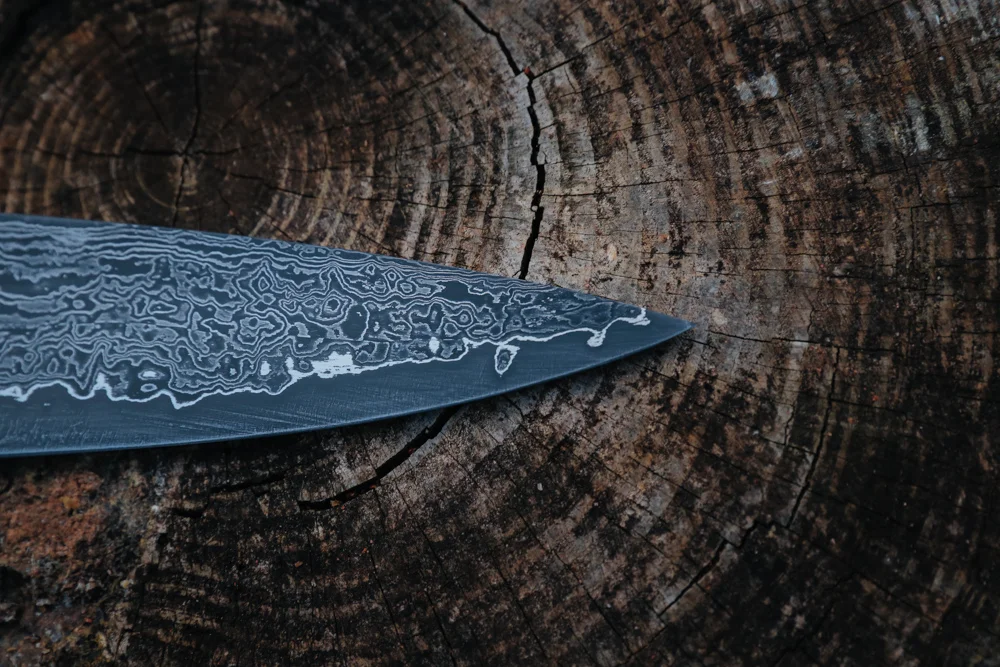
The revealed core along the edge on the right side of this chefs knife turned out very even. It means the thickness of the jacket steel (damascus) was even in terms of what I had to grind off for the geometry I was going for.
In addition to damascus, I've also had an urge to learn more about san mai, a Japanese lamination of steels - a jacket or cladding and a center, core steel. Usually, this is a very high carbon steel core that might be brittle on its own, sandwiched between two pieces of softer, stainless steel or pure iron that protects the core steel from damage and provides a soft metal to grind away when sharpening. Furthermore, the majority of the exposed surface on a san mai blade will be the jacket material and if this happens to be stainless steel - while you still need to prevent your cutting edge from rusting, you essentially have a lower maintenance knife. As typical in all the Japanese traditions I know if, this is a sensible approach one can't really argue with. Everything about it makes sense - from the method of creation to the end user's experience, really get the best of the best - benefitting from multiple alloy's characteristics in a single knife.
Because I'd like to start using the portion of my recycled steel that is non-perfect to making damascus and still make a high performance knife, I decided to laminate my pattern welded / damascus steel to a high performance cutlery steel, in this case, I chose virgin 52100. I feel satisfied by this approach - though labor intensive in my shop, entirely hammered and folded by hand with a 1500 gram hammer and an anvil, it's rewarding work with a natural beauty of its own.

On the opposing side, there's a less even distribution of the jacket steel - higher and lower spots from the hand forging process (and my own shortcomings!) - create a variegated core reveal. Acceptable, but not desireable.
Stay tuned for more on damascus and san mai from Heartwood Forge this year!
best,
Will


